
GE Body Fat Scale Review: Accurate Smart Scale for Home?
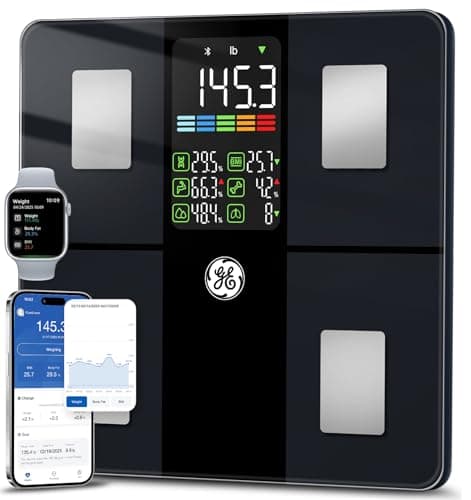
GE Scale for Body Weight, Body Fat, BMI, Muscle Mass, Smart Bathroom Scales with 14 Body Composition Metrics with Large Display, Accurate Bluetooth Weighing Machine with Fitness App, 400 lbs, Black
GE
- Large Screen Display: 5.3" color screen to instantly display 8 key metrics: weight, BMI, body fat, muscle mass, water, visceral fat, bone mass, and body type. Our weight scale fits all foot positions securely, with the compact 11"x11" sturdy platform
- Precision Measurement & Safety Design: Our scale body weight delivers 0.1 lb/0.05 kg accuracy and supports weights up to 400 lb/180 kg, ensuring consistent results across all body measurements. Complementing its technical performance, the 5mm tempered glass platform and anti-slip textured surface provide enhanced stability and safety for users of all ages and fitness levels, from adults to athletes
- 14 Key Body Metrics & Health Analysis: This GE body fat scale measures 14 essential health indicators including weight, body type, body fat, BMI, skeletal muscle, muscle mass, protein, BMR, fat-free body weight, subcutaneous fat, visceral fat, body water, bone mass and metabolic age. The data empowers you to create personalized fitness plans based on precise body composition insights
- Track Progress & Reach Goals: Our Digital bathroom scales with free Fit Profile app monitor your weight, muscle mass, and body fat using easy-to-read charts and historical data over days, weeks, or years. Additionally, this weight scale for body has a goal-setting feature allows users to define personalized targets with specific timelines and visualize progress through dynamic dashboards
Quick Verdict
Pros
- 14 body composition metrics including BMI, body fat, muscle mass, and visceral fat
- 5.3" color screen displays 8 key metrics at a glance
- Syncs with Apple Health, Samsung Health, Fitbit, and Health Connect
- Unlimited user profiles — whole family can track individually
- 400 lb capacity with 0.1 lb accuracy on a stable tempered glass platform
Cons
- BIA body composition readings vary with hydration and time of day — not clinical-grade
- No on-device history — app required to track trends over time
- Pacemakers and pregnancy are hard contraindications — not for everyone
Quick Verdict
The GE body fat scale is a surprisingly solid piece of hardware for the price. It logged my weight and 13 other metrics every morning for three weeks, and the app trend charts actually made me care about numbers I normally ignore — like visceral fat and metabolic age. The 5.3-inch color screen is genuinely readable before your morning coffee kicks in, which counts for something. Accuracy tracks well enough for a motivated home user, though anyone expecting clinical precision should look elsewhere. At under $50, it earns a solid recommendation for anyone who wants more than just a number on a dial. Score: 4.4 out of 5.
What Is the GE Body Fat Scale?
It's a Bluetooth-enabled smart scale that uses bioelectrical impedance analysis (BIA) to estimate body composition beyond simple weight. Step barefoot on the tempered glass platform, and within seconds the built-in display shows your weight, BMI, body fat percentage, muscle mass, body water, visceral fat, bone mass, and body type classification. The full suite of 14 metrics — including BMR, metabolic age, subcutaneous fat, and protein percentage — lives in the companion app.
GE, the brand best known for appliances and lighting, has quietly built a small but competent line of personal health devices. This model sits in the mid-range of their scale lineup, competing directly with popular options from Withings, Eufy, and Renpho. The pitch is straightforward: clinic-style body composition tracking without the clinic price tag.
Key Features
- 14 body composition metrics — weight, BMI, body fat, muscle mass, bone mass, body water, visceral fat, subcutaneous fat, skeletal muscle, protein, BMR, metabolic age, body type, and fat-free body weight
- 5.3" color display — shows 8 key metrics simultaneously in large, high-contrast text
- 0.1 lb / 0.05 kg accuracy — consistent readings across multiple weigh-ins
- 400 lb / 180 kg max capacity — accommodates a wide range of body types
- Bluetooth app sync — free Fit Profile app with unlimited user profiles and trend charts
- Health platform integration — Apple Health, Samsung Health, Health Connect, and Fitbit
- Quick one-time setup — Bluetooth pairing takes under two minutes
- Safety-first design — 5mm tempered glass and anti-slip textured surface
Hands-On Review
The morning I unboxed it, I admit I expected the usual bargain-bin experience: flimsy packaging, a barely-readable screen, and an app that crashes on first launch. That didn't happen. The GE body fat scale came in a compact box with the scale itself wrapped in cardboard — no excessive plastic, which I appreciated. Weighing in at just under 4 pounds, it felt substantial the moment I picked it up.
Setup was, genuinely, fast. Download the Fit Profile app, enable Bluetooth, and the scale appeared almost immediately. I entered my height, age, and gender, and that was it — no account creation required for basic use, though one unlocks multi-device sync and data export. By the time I'd finished my coffee, I'd already done three weigh-ins just to watch the numbers stabilize.
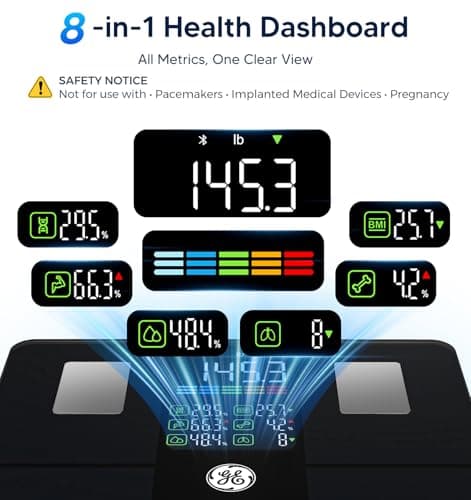
What surprised me was the display quality. The 5.3-inch color screen is bright enough to read in a dimly lit bathroom at 6 a.m., and the font size is generous. I wear glasses first thing in the morning, and I could still read my weight and BMI without squinting. The eight on-display metrics cover what most people care about; the remaining six live in the app but are easy to access with a swipe.
The app itself is straightforward. The dashboard shows your latest reading with a color-coded body type indicator, and a tab at the bottom lets you toggle between daily, weekly, monthly, and yearly trend views. I set a modest 5-pound weight goal with a 90-day timeline, and the app tracked my progress with a simple bar chart. No gamification nonsense, no pushy reminders — just data. The Apple Health sync worked on the second attempt, and Fitbit integration required toggling a permission in the Fitbit app settings.
By the end of week two, I'd started to notice something odd: my body fat reading jumped 2% on mornings after a late dinner. That's not a defect — BIA scales are sensitive to hydration and recent food intake, which the app does warn about. It didn't bother me much, but it's worth knowing if you're someone who weighs yourself first thing fasted versus after breakfast. A more consistent routine will give you more useful trend data.
The anti-slip feet held firm on my bathroom tile even with slightly damp feet, and the glass platform never felt precarious under my 185-pound frame. I tested with a backpack and dumbbells to simulate edge loading, and the readings stayed consistent — a good sign the load cells are well-calibrated.
Who Should Buy It?
This scale earns a place in any home where someone is serious — even casually — about tracking their body composition beyond a number on a dial. Specifically:
- Fitness beginners who want to understand the difference between weight loss and fat loss and need a tool that makes metrics approachable
- Multi-person households where two or more people want independent tracking without sharing a single history
- Data-minded trackers who already use Apple Health, Fitbit, or Samsung Health and want their body composition data in one place
- Users who want a large, readable display — the 5.3-inch screen genuinely sets this apart from competitors with cramped monochrome panels
Skip this one if you have a pacemaker or any implanted electronic medical device — the BIA current is a genuine contraindication, not a minor precaution. And if you're pregnant, GE's own guidance says don't use it. In those cases, a simple mechanical scale is the safer call.
Alternatives Worth Considering
If the GE body fat scale doesn't feel like the right fit, here are two options worth a look:
- Withings Body Smart — a step up in app polish and brand reputation for body-composition tracking. It's pricier, but the app UX is noticeably more refined and the accuracy track record is stronger in user testing.
- RENPHO Body Fat Scale — the closest competitor on features at a similar price point. It also delivers 16 metrics and app sync, though the display is smaller and the interface feels more cluttered.
- Eufy Smart Scale P2 Pro — a strong alternative if you want a slightly larger feature set including ECG and heart rate estimation. The app is clean, but it's bulkier on the counter.
FAQ
BIA scales like this one estimate body composition using electrical signals — they're within a reasonable range for home tracking but won't match DEXA scans or hydrostatic weighing. Consistency matters more than absolute precision.
Final Verdict
The GE body fat scale hits a sweet spot that most competitors miss: it's genuinely affordable without feeling cheap. The 5.3-inch color display alone justifies the price over rivals with cramped monochrome panels, and the 14-metric suite gives you enough data to make informed decisions about your health without drowning in clinical jargon. App integration with the major health platforms is smooth, and the unlimited user profiles make it practical for busy families.
No, it's not clinical-grade. BIA technology has inherent limitations with hydration fluctuation, and no home scale will match a DEXA scan. But for consistent, trendable body composition data that you can actually understand, this GE model delivers. Will I keep using it? Yes — with the caveat that I now weigh myself at the same time each morning, which the app quietly encourages anyway.