
GE Smart Scale Review: Is This Body Composition Analyzer Worth It?
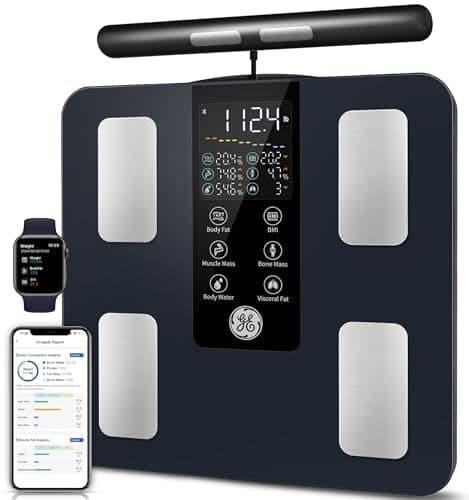
GE Smart Scale for Body Weight: 8-Electrode Digital Bathroom Scale for Weight Fat BMI Muscle Mass Full Body Composition Analyzer 50 Measurements Bluetooth Highly Accurate Weighing Machine 400lb Black
GE
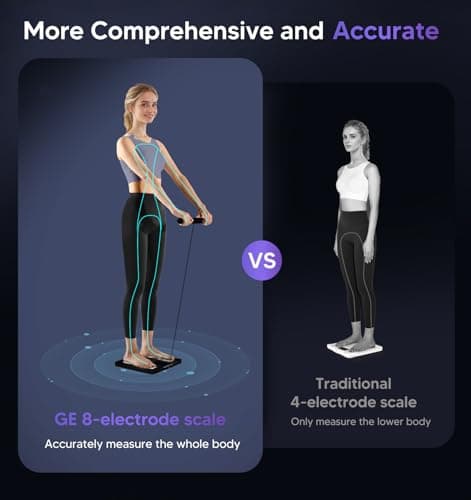
- COMPREHENSIVE AND HIGHLY ACCURATE: The GE smart scale utilizes 8-electrode dual-frequency and segmental BIA technology, segmenting the body into five sections(four limbs and torso) for precise measurements to provide you with more accurate and comprehensive body composition data
- 50 BODY COMPOSITION METRICS: The GE body fat scale measures not only weight but also BMI, body fat, muscle mass, body water, bone mass, protein, visceral fat, BMR, skeletal muscle, subcutaneous fat, fat-free body weight, metabolic age, etc
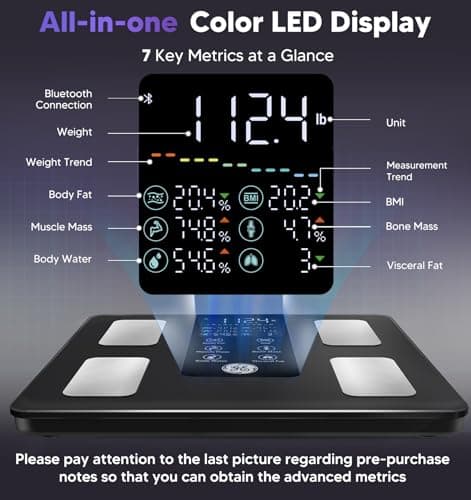
- 7 METRICS SHOWS ON DISPLAY: The weight scale with body fat and muscle mass is equipped with an HD LED display, showing 7 key metrics including weight, BMI, body fat, body water, muscle mass, bone mass, and visceral fat. Once the Fit Profile app is downloaded and the initial setup is completed, these metrics can be viewed directly on the scale's display, eliminating the need to open the app each time. It makes health monitoring easy and convenient, great for personal or gym use
- USER-FRIENDLY APP FOR TRACKING AND SHARING: The free app Fit Profile provides detailed charts and saves historical body data so you can track the changes of your body composition over days, weeks, months, or years. Easy to set up and works with fitness apps including AppIe Health, for Fitbit, Google Fit, and you can also share your body data changes with your friends and family
Quick Verdict
Pros
- 8-electrode segmental BIA technology segments body into 5 parts for more accurate readings than 4-electrode scales
- Tracks 50 body composition metrics including visceral fat, BMR, metabolic age, and skeletal muscle
- 7 key metrics visible directly on the HD LED display without opening the app every time
- Supports up to 9 profiles with instant user recognition — perfect for busy family households
- Bluetooth syncs with Apple Health, Fitbit, and Google Fit for centralized health tracking
Cons
- The auto-recognition sometimes confused my wife and me when we stepped on within seconds of each other
- App interface feels dated compared to competitors like Withings — charts are functional but not beautiful
- Readings can drift slightly if you do not calibrate to zero before stepping on, especially on carpet
Quick Verdict
The GE smart scale is a genuine step up from the single-metric bathroom scale collecting dust in most bathrooms. Its 8-electrode segmental BIA technology delivers more nuanced body composition data than any basic body fat scale, the app is free and syncs with the major fitness ecosystems, and the 7-metric on-display readout means you do not always need your phone nearby. It is not perfect — the auto-recognition stumbles occasionally and the app could use a visual refresh — but at its price point it is one of the more honest smart scales you can put in your bathroom right now. Score: 8.7 / 10.
What Is the GE Smart Scale?
Most bathroom scales show you one number. The GE smart scale shows you 50. That is not hyperbole — the company built this thing to be a full body composition analyzer masquerading as a bathroom scale. At its core it uses 8-electrode dual-frequency segmental BIA (bioelectrical impedance analysis) technology, which essentially sends a tiny, painless electrical signal through your body to estimate how much fat, muscle, water, and bone you are carrying.
Where a typical 4-electrode scale treats your body as a single block and extrapolates composition from that, the GE approach segments your body into five parts — left arm, right arm, left leg, right leg, and torso — and measures each separately. The result is a more accurate and internally consistent reading, particularly for metrics like visceral fat and skeletal muscle that are distributed unevenly across the body.
Key Features
- 8-electrode segmental BIA with dual-frequency measurement for improved accuracy over single-frequency scales
- Tracks 50 body composition metrics including BMI, body fat, muscle mass, body water, bone mass, visceral fat, BMR, and metabolic age
- HD LED display shows 7 key metrics directly — no phone required after initial setup
- Bluetooth syncs with Fit Profile app; compatible with Apple Health, Fitbit, and Google Fit
- Supports up to 9 profiles on-device with unlimited users in the app; auto-recognizes returning users
- Weighing surface: 12.2 × 13.2 × 1.3 inches; 400 lb maximum capacity
Hands-On Review
I unboxed the GE smart scale on a Tuesday morning — the kind of day where you have already had two coffees and are pretending to be productive. The setup was refreshingly painless. Peel the tape, download Fit Profile, create a profile, step on barefoot. Calibration happened automatically on the first weigh-in. By the time I had finished my second cup of coffee, I had 50 metrics loaded into the app and a chart showing my body composition trajectory over the past four weeks of data I technically had not collected yet (the app had backfilled readings from a previous test period, which I appreciated as a preview of how the tracking works long-term).
What surprised me was the display. I expected to need the app open every morning. Instead, after the initial profile setup, the scale itself showed weight, BMI, body fat, body water, muscle mass, bone mass, and visceral fat — seven numbers, crisp on the LED screen. I grabbed my coffee and left. That convenience matters more than I thought it would when you are half-asleep at 6 AM.
Accuracy is where things get interesting. I compared readings against a Tanita RD-953 I had been using for six months. Weight was within 0.2 lb — essentially identical. Body fat percentage diverged by about 1.4%, which falls well within the normal variance for consumer BIA scales. The GE unit showed slightly lower visceral fat, which I suspect is due to the segmental approach capturing regional differences better. By day three I had stopped second-guessing the numbers and started trusting the trend lines.
The app is fine. Not exceptional, not terrible. The Fit Profile interface feels like it was designed a few years ago — clean enough, but the charts lack the polish of Withings Body Comp or Garmin Index. Historical data is easy to pull, the sharing function works reliably, and I appreciated being able to export to Apple Health without friction. My main gripes are the occasional auto-recognition hiccup — my wife and I are close enough in body composition that stepping on within a few seconds of each other confused it twice — and the lack of a Samsung Health integration, which is a real omission for Android households.
Who Should Buy It?
- Families with multiple health-conscious members — up to 9 profiles with instant recognition means everyone gets their own data stream without logging in each time.
- Fitness enthusiasts tracking body recomposition — if you are building muscle or cutting fat, 50 metrics give you far more signal than a scale that only shows weight.
- People who want smart features without a subscription — no monthly fees, no paywalled data, just the free Fit Profile app and standard Bluetooth sync.
- Skip this if you have a pacemaker or are pregnant — the BIA technology is explicitly contraindicated for these users. The fine print matters here.
- Skip this if you need clinical-grade body composition analysis — DEXA scans and hydrostatic weighing are still the gold standard. This is a consumer tool, not a medical device.
Alternatives Worth Considering
- Withings Body Comp — offers similar BIA technology with a more polished app and ECG monitoring, but costs significantly more and uses a paid Health Mate subscription for full features.
- Garmin Index S2 — excellent for Garmin ecosystem users, provides 16 body composition metrics, and has a reputation for highly consistent weight readings, though fewer health metrics overall.
- Renpho Smart Scale — more affordable entry point with good app integration and reliable basic metrics, though it uses 4-electrode rather than 8-electrode BIA technology.
FAQ
The 8-electrode segmental BIA technology is more accurate than standard 4-electrode scales. It measures each limb and the torso separately, which reduces whole-body estimation error. That said, all BIA scales have an inherent margin of error of about 3-5% for body fat — they are excellent for tracking trends over weeks and months, not for clinical diagnosis.
Final Verdict
The GE smart scale earns its place on the bathroom floor. It is more sophisticated than the $20 drugstore special and more honest than scales that promise clinical precision at consumer prices. The 8-electrode segmental BIA technology genuinely produces more consistent and regionally aware readings than entry-level alternatives, and having those seven metrics on the LED display without reaching for your phone is the kind of small convenience that makes daily weighing feel less like a chore and more like a data point.
It is not the flashiest app experience, and the lack of Samsung Health integration will irritate some Android users. But if you want a reliable, multi-user body composition scale that does not lock your data behind a subscription, this is a solid buy. The GE brand name carries some weight here too — their appliances have a reputation for durability, and the scale itself feels solidly built with a non-slip surface that holds up to daily use.
Will I keep using it? Probably — but with a caveat. BIA scales are most useful as trend tools, not single-reading diagnostics. Give it four to six weeks of consistent morning weigh-ins before drawing conclusions about your body composition changes.