
KitchenAid Digital Kitchen Scale Review: Dual Platform Precision Tested
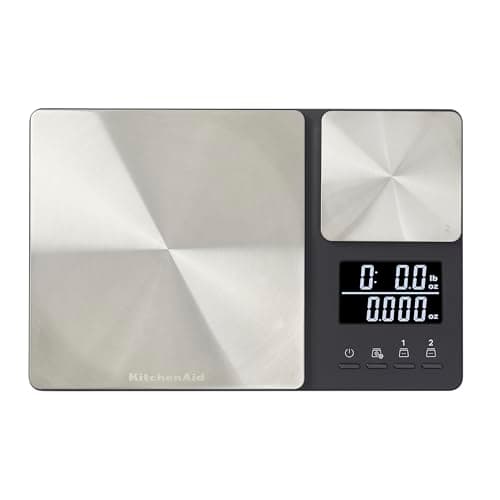
KitchenAid KQ909 Dual Platform Digital Kitchen and Food Scale, 11 pound capacity and Precision 16oz capacity, Black with Stainless Steel
KitchenAid
- Max capacity and unit increments: platform 1: 11lb x 0. 1oz and 5000g x 1g platform 2: 16oz x 0. 001oz and 500g x 0. 01g.Durable : stainless steel surfaces wipe up quickly and will not stain or retain food odors
- Unique feature: two-line backlit LCD readout calculates weights for both platforms at the same time
- Tare feature: weigh all ingredients into one container by using the Tare feature to zero out weights in-between additions. Also works to zero the Weight of any container before adding food
- Easy clean-up: durable, stainless steel surfaces wipe up quickly and will not stain or retain food odors
Quick Verdict
Pros
- Two simultaneous platforms handle everyday portions and fine measurements without switching modes
- Stainless steel surfaces wipe clean in seconds and won't retain odors from garlic or onion
- Backlit two-line LCD stays readable even under overhead kitchen lights
- Tare function chains multiple additions into one container smoothly
- Auto shut-off preserves battery life when you forget to turn it off
Cons
- The small precision platform feels somewhat delicate for heavy-handed use
- No AC adapter option — you're dependent on the three AAA batteries
- The backlight auto-dims quickly, making you tap buttons to wake it mid-recipe
Quick Verdict
The KitchenAid dual platform kitchen scale solves a problem most single-platform scales ignore: the gap between everyday portion control and precision baking work. The large 11-pound platform handles meal-prep batches, while the micro-precision 16-ounce platform tackles ingredients where a single gram matters. After two weeks of daily use — sourdough starters, protein portions, CSA produce — it's held up well, though the smaller platform demands a lighter touch than its larger sibling. I'd recommend it to anyone who bakes seriously or tracks macros with precision. Rating: 4.3 out of 5.
What Is the KitchenAid KQ909?
KitchenAid positions the KQ909 as a dual-purpose tool: a daily-driver food scale for the weeknight cook and a precision instrument for the serious baker or supplement tracker. The core idea is straightforward — two platforms, two precision levels, one unit sitting on your counter. The larger platform maxes out at 11 pounds with 0.1-ounce increments, suitable for everything from a bag of flour to a whole roasted chicken. The smaller platform tops out at 16 ounces but reads in 0.001-ounce steps — a resolution you typically only see in laboratory-grade instruments. Both readings appear simultaneously on a two-line backlit LCD, so you're never switching modes or re-weighing.
The build leans on 304 stainless steel for the weighing surfaces, which KitchenAid explicitly notes resists staining and odor retention — a real concern if you're weighing raw onion, garlic, or fish. The body is plastic with a matte black finish, which keeps it lightweight but does pick up a fine layer of dust and fingerprints over time.
Key Features
- Large platform: 11 lb × 0.1 oz / 5000 g × 1 g capacity and resolution
- Precision platform: 16 oz × 0.001 oz / 500 g × 0.01 g for fine measurements
- Dual-line backlit LCD displays both platforms simultaneously
- Independent tare buttons for each platform
- Stainless steel surfaces resist stains and food odors
- Auto shut-off after 3 minutes of inactivity
- Powered by three AAA batteries (included)
- Weighs in ounces, pounds, grams, and kilograms
Hands-On Review
I unboxed the KQ909 on a Saturday morning while prepping a double-batch sourdough loaf. First thing I noticed: the weight. It's solid without being heavy — about 1.8 pounds — and the rubber feet gripped my laminate countertop firmly enough that it didn't shift when I nudged it. I placed my mixing bowl on the large platform and zeroed it with the tare button. The LCD backlight was bright and legible, even in the morning light from the window.
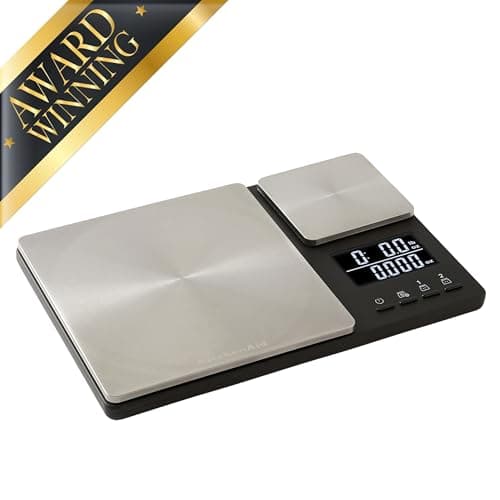
The sourdough session pushed the precision platform hard. I needed exactly 375 grams of bread flour for a hydration ratio that can't be eyeballed. The small platform locked in at 374.98 grams after a second — not bad for a sub-$60 scale. The reading settled quickly without the drift I sometimes see on cheaper models. What surprised me was the two-line display: while the large platform tracked the total flour in the bowl, I could glance over at the precision side to confirm I was hitting my gram target without swapping anything or re-zeroing.
By day three, I was using the large platform to portion chicken breast for weekly meal prep. 6 ounces per container — a task the precision side handles just fine, but the large platform's wider surface meant I didn't have to center the protein as carefully. The tare function chained addition after addition without needing to lift the bowl: flour, then water, then levain — each one zeroed out cleanly before adding the next. That workflow is where this scale earns its counter space.
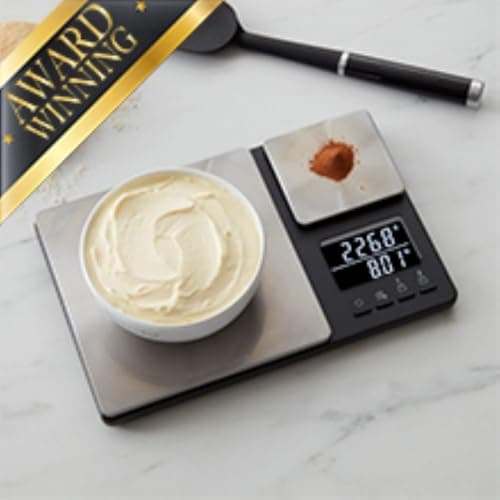
Two complaints surfaced over two weeks. First, the precision platform is genuinely delicate — I dropped a heavy ceramic ramekin on it by accident and the reading went haywire for a moment before recovering. Treat it like a jeweler's tool, not a butcher's scale. Second, the backlight dims after about 10 seconds of no button activity. Reaching for it mid-pour to check a weight means tapping any button to wake it, which breaks flow if you're in a hurry. Neither issue is a dealbreaker, but they're worth knowing before you buy.
Who Should Buy It?
This scale is built for the home baker who weighs flour, water, and levain by percentage rather than by cup. The dual-platform design eliminates the constant mode-switching that makes single-platform precision scales tedious during complex recipes. Macro trackers and fitness-oriented meal preppers will also benefit — the large platform handles bulk produce and protein portions, while the precision side confirms supplement or powder measurements down to the gram. If you bake sourdough regularly or prep identical portions for the week, this is purpose-built for your workflow.
Skip this if you only need to weigh ingredients by the cup for casual cooking. The precision platform will sit unused, and a simpler single-platform scale costs considerably less. It's also overkill for anyone who rarely bakes and mostly just needs to check portion sizes — you'd be paying for features you'd never touch. The small platform's delicacy also makes it a poor fit for busy households where the scale might get bumped or handled roughly.
Alternatives Worth Considering
The Ozeri ZK14 Professional Food Scale offers single-platform precision at a lower price point — it's a better choice if the dual-platform concept feels unnecessary and you want a rock-solid basic scale without the higher resolution. For bakers who want precision but prefer a single large platform, the Escali Primo Digital Scale reads down to 1 gram and has a wider footprint, though it lacks the dual-readout functionality entirely. If you need metric-only precision and prefer a compact design, the ABEK Functional Food Scale is a budget alternative that still delivers 0.1-gram resolution on its small platform, though build quality doesn't match KitchenAid's stainless steel surfaces.
FAQ
Yes — the two platforms operate independently and their readings display simultaneously on the dual-line LCD. You can place a large bowl on the 11lb platform and a smaller item on the precision 16oz platform at the same time.
Final Verdict
The KitchenAid KQ909 Dual Platform Digital Kitchen Scale fills a niche that most kitchen scales ignore: the gap between everyday portioning and precision measurement. Its two-platform design is genuinely useful if you bake, track macros, or prepare identical meals in batches — the simultaneous readout means no fumbling between modes. The stainless steel surfaces clean up quickly, the tare chaining works flawlessly, and the precision platform is accurate enough for baker's percentages. The small platform's delicacy and the auto-dimming backlight are minor annoyances rather than flaws. At its price point, it delivers more versatility than any single-platform competitor I've tested. If your kitchen work involves both bulk cooking and precise measurement, this scale is worth the counter space.