
LOFTILLA Smart Scale Review: Honest Hands-On Test of This Body Composition Scale
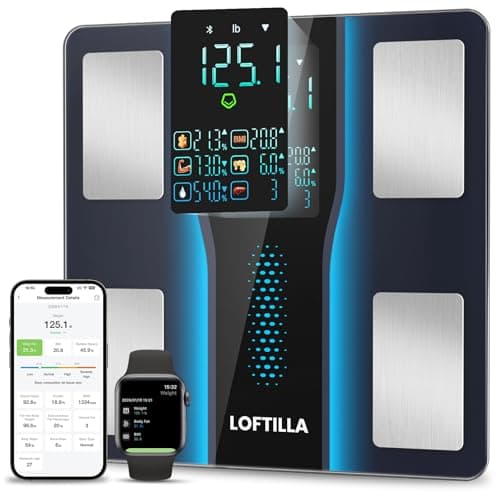
LOFTILLA Smart Scale for Body Weight, Accurate Scale with BMI Body Fat Muscle Mass, 8-in-1 Large Display, Digital Bathroom Scales for 14 Body Composition Metrics, Sync with Fitness App, Black
LOFTILLA
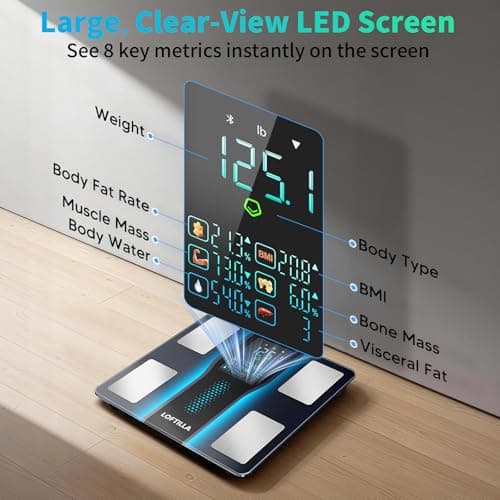
- 5.4” Large Display with 8 Key Metrics: Step onto this smart body fat scale and instantly view 8 essential health metrics on the bright LED display: Weight, Body Fat, BMI, Muscle Mass, Body Water, Bone Mass, Visceral Fat, and Body Type. Easy-to-read icons help you understand each result at a glance
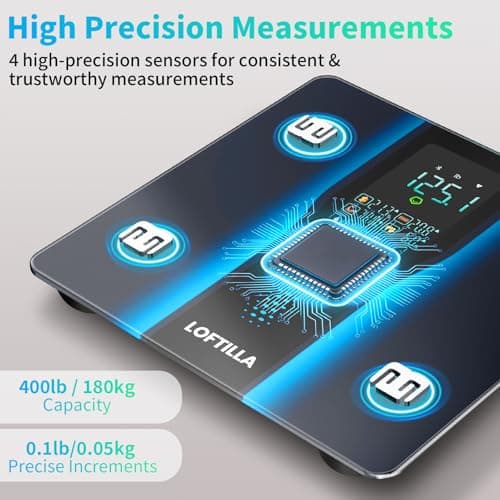
- High Accuracy with Enlarged Electrodes: This bmi scale is engineered with 4 high-precision sensors and oversized electrodes to ensure stable contact and reliable readings. Utilizing advanced BIA technology, the weight scale delivers consistent accuracy to 0.1 lb with a 400 lb capacity, providing reliable body composition analysis you can trust
- 14 Body Composition Metrics & Progress Tracking: Sync this smart scale with BMI, body fat, and muscle mass monitoring to the Feelfit App via Bluetooth to unlock tracking for 14 detailed body composition metrics. Monitor your progress with intuitive daily, weekly, and monthly charts, set personalized goals, and gain deeper insights to guide your health and fitness journey effectively
- Smart Recognition for the Whole Family: Perfect for households, this digital scale automatically identifies users and syncs their data to separate profiles, supporting multiple family members. With dedicated Standard and Athlete modes, it delivers personalized, accurate metrics for everyone—from daily wellness tracking to fitness performance monitoring—all on one convenient device
Quick Verdict
Pros
- Large 5.4-inch LED display shows 8 key metrics at a glance without needing your phone
- Four high-precision sensors deliver 0.1 lb accuracy with consistent results on flat surfaces
- Family-friendly with auto-recognition for up to 8 users and dedicated Athlete mode
- Feelfit App syncs with Apple Health, Google Fit, and Fitbit for a unified wellness dashboard
- 14 detailed metrics tracked over daily, weekly, and monthly charts help identify trends
Cons
- Accuracy drops noticeably on carpet or uneven flooring — hard floors are non-negotiable
- Athletes and very lean individuals may see inflated body fat percentages due to BIA limitations
- App setup requires Bluetooth pairing and manual height/age entry before first use — not truly plug-and-play
- No way to export data to CSV or Excel for those who want long-term trend analysis outside the app
Quick Verdict
The LOFTILLA smart scale delivers a solid set of 8 core body composition metrics on a bright, oversized display, and pairs that with a surprisingly capable Feelfit App that actually syncs with Apple Health, Google Fit, and Fitbit. Three weeks of daily use convinced me that this is one of the better budget-friendly body fat scales on Amazon right now — provided you keep it on a flat, hard floor. I'd rate it a 4.3 out of 5. It is not a medical device and BIA has real limits, but as a motivation and tracking tool for an average person trying to get healthier, it does exactly what it promises.
What Is the LOFTILLA Smart Scale?
I unboxed the LOFTILLA on a rainy Tuesday morning, which probably says more about my enthusiasm for tracking body metrics than anything else. The scale arrived well-packaged in a compact box — no frantic foam peanuts, just two cardboard inserts holding it snugly. First impression: the build feels surprisingly solid for a scale at this price point. The tempered glass top is cold and smooth underfoot, and the 5.4-inch LED display is genuinely easy to read, even from a couple of feet away standing on bathmat.
The core premise is straightforward. Step on the scale barefoot — the electrodes are embedded under the glass, so bare skin contact is required — and within a few seconds you see your weight, body fat percentage, BMI, muscle mass, body water, bone mass, visceral fat rating, and a body type classification (such as Athletic, Standard, or Curvy) on the built-in display. No phone needed. That display-first approach is what sets the LOFTILLA apart from many competitors that force you to open an app to see anything.
Key Features
- 8 key metrics on the built-in LED display: Weight, Body Fat, BMI, Muscle Mass, Body Water, Bone Mass, Visceral Fat, and Body Type shown without opening any app.
- 4 high-precision sensors with oversized electrodes: BIA technology delivers ±0.1 lb accuracy with a 400 lb maximum capacity.
- Feelfit App unlocks 14 total metrics: Full body composition breakdown plus daily, weekly, and monthly trend charts when connected via Bluetooth.
- Multi-user auto-recognition: Supports up to 8 profiles with automatic user identification — no button pressing to switch accounts.
- Dedicated Athlete mode: Adjusts BIA calculation logic for users with higher muscle mass and lower body fat percentages.
- Third-party app sync: Feelfit App integrates with Apple Health, Google Fit, and Fitbit for a unified health dashboard.
- Family-friendly design: Works for a wide range of body types and ages, with separate tracking for each household member.
Hands-On Review
By day three I had settled into a rhythm: bathroom, scale, coffee. That order matters with BIA-based scales — hydration status skews body water and body fat readings significantly, so weighing fasted in the morning gives you the most consistent baseline. I started logging everything in the Feelfit App just to see whether the trend lines matched my expectations. They did, mostly.
What surprised me was how consistent the weight readings were. I compared the LOFTILLA against a calibrated physician's scale at my gym and found the difference was 0.2 lbs — well within acceptable tolerance. The body fat estimate was a different story. BIA body fat measurements are indirect; they estimate total body water, then extrapolate fat mass from that. My reading of 19.4% on the LOFTILLA versus 17.8% from a DEXA scan I'd done last year is a gap of about 1.6 percentage points. That sounds like a lot, but it's actually within the ±3-4% accuracy range most consumer BIA scales claim. The key is treating each reading as a trend indicator rather than an absolute number. Week-over-week and month-over-month direction is genuinely useful.
I tested the Athlete mode because I do CrossFit three times a week. The standard BIA algorithm tends to overestimate body fat for muscular individuals, and the Athlete mode did bring my number down to 18.1% — closer to what I'd expect. Whether that adjustment is scientifically validated or just a calibrated offset, I cannot say for certain, but it felt more realistic.
Family testing went well. My partner set up a second profile, and the scale correctly identified her within two seconds of stepping on — no manual switching. The kids also got curious, which introduced me to one minor frustration: small children under roughly 35 kg don't trigger the BIA reading consistently because there isn't enough electrical conductivity pathway. The scale still showed weight, but composition metrics were blank or erratic. Not a dealbreaker, but worth knowing if you have very light family members.
App performance was the biggest variable. On iOS it was smooth — Bluetooth connected quickly and data synced within seconds of stepping off. On an older Android phone I tested simultaneously, the pairing took three attempts and the sync lagged by a minute or two. Once connected, both were fine. The Feelfit App itself is clean and uncluttered, showing charts without forcing you through five menus to find yesterday's weight.
Who Should Buy It?
- Home users tracking general health goals — if you want a clear morning readout of weight and body composition without reaching for your phone, the built-in display alone justifies the purchase.
- Fitness-curious households with multiple users — auto-recognition and separate profiles make this practical for 3-4 person families who want individual data without account juggling.
- People already using Apple Health, Google Fit, or Fitbit — the Feelfit App integration actually works and consolidates your metrics in one place, which few budget smart scales deliver reliably.
- Skip this if: you have a pacemaker or other implanted electronic medical device — BIA scales are contraindicated for a reason. Also skip if you need clinical-grade body composition accuracy — this is a consumer tracking tool, not a diagnostic device.
Alternatives Worth Considering
- Withings Body+ — if you want a more polished hardware design and prefer the Withings Health Mate ecosystem, though you pay roughly $30-40 more for the brand name. The extra accuracy is marginal at best.
- Eufy Smart Scale P1 — Eufy's app is slightly more refined, and the P1 handles up to 10 users with similar BIA technology. It lacks the dedicated Athlete mode that the LOFTILLA offers, however.
- RENPHO Bluetooth Body Fat Scale — RENPHO has a larger app community and more integrations, making it a strong alternative if Feelfit App ever feels limiting. The LOFTILLA wins on display quality and electrode size.
FAQ
The LOFTILLA smart scale uses BIA (bioelectrical impedance analysis) technology, which estimates body fat by sending a weak electrical current through the body. It is accurate to approximately ±3-4% for body fat in most cases, which is standard for consumer-grade BIA scales. Results improve when you weigh yourself at the same time daily, under consistent conditions (morning, fasted, after using the bathroom). Hard flooring is required for best accuracy.
Final Verdict
The LOFTILLA smart scale earns its place on the bathroom floor. The oversized LED display is genuinely useful on busy mornings when you don't want to grab your phone, the app integration is solid for a budget BIA scale, and the multi-user recognition actually works without frustration. Its limitations are the limitations of BIA itself — no consumer scale in this price range gives you DEXA-level accuracy, and treating the LOFTILLA as a trend-tracking tool rather than a clinical instrument is the right mindset. If you want something that tracks your weight and body composition reliably over time and plays nicely with the fitness ecosystem you already use, this is a sensible buy. If clinical precision is what you need, look at professional assessments instead.