
ProsourceFit Exercise Balance Pad Review: Worth It in 2024?
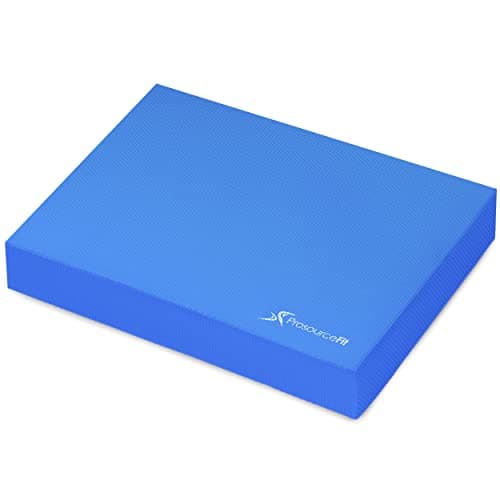
ProsourceFit Exercise Balance Pad – Non-Slip Cushioned Foam Mat & Knee Pad for Fitness and Stability Training, Yoga, Physical Therapy 15.5”x12.75”, Blue
ProsourceFit
- IMPROVE BALANCE & STRENGTH – Foam creates unstable surface for working on balance & core strength, which also strengthens feet/ankles for rehabilitation after injuries
- ALL FITNESS LEVELS – A challenge for athletes who want to improve functionality & power; a great tool for beginners & older adults to increase body awareness and enhance stability
- NON-TOXIC & NON-SLIP – Environmentally conscious TPE material is sweat-proof and slip-resistant, making it perfect for sweaty workouts and yoga and is easy to clean afterward
- MULTIPLE USES – Versatile pad can be used as a seat cushion, a knee pad for gardening, a foot pad for standing desks, as a meditation pillow, or for making yoga poses more challenging
Quick Verdict
Pros
- Lightweight at 12 oz — tosses into a gym bag without weighing you down
- Non-toxic TPE material resists sweat and wipes clean in seconds
- Unstable surface genuinely fires up stabilizing muscles during basic moves
- Large enough for lunges and planks without feeling cramped
- Versatile enough for standing desks, gardening, or meditation
Cons
- At 2.25 inches it compresses noticeably under heavier users (200+ lbs)
- Blue color shows sweat marks more than darker alternatives would
- No carry strap or handles — you just grab the whole pad
Quick Verdict
The ProsourceFit balance pad is a no-frills stability tool that does exactly what the listing promises: it creates a slightly unstable surface and forces your stabilizing muscles to work harder during strength moves and yoga. It's not the thickest or most premium pad on the market, but at this price point it is hard to beat. I give it a 4.3 out of 5 for most fitness buyers.
What Is the ProsourceFit Exercise Balance Pad?
On a Tuesday morning in early October I unboxed this thing and genuinely had no idea where to put it. My apartment does not have a home gym. It has a corner of a bedroom with a yoga mat and a dumbbell rack that leans slightly to the left. I set the pad on the hardwood, stepped on it, and immediately felt my calves and inner thighs light up in a way a flat mat never produces.
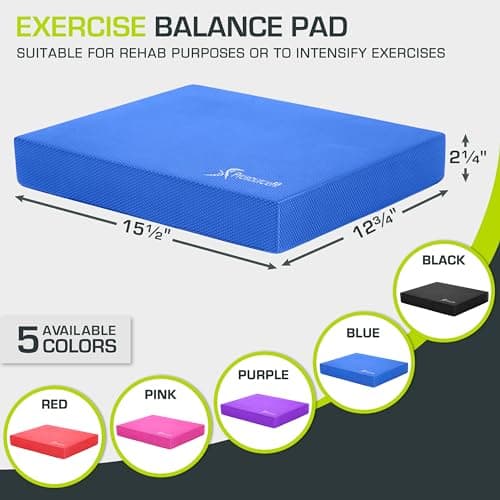
ProsourceFit describes this as a cushiony foam square made from TPE — the same material used in yoga mats that want to call themselves eco-friendly. The blue color is cheerful in a way that feels slightly too optimistic for a piece of fitness equipment, but it is what it is. The pad measures 15.5 inches long by 12.75 inches wide, which sounds modest until you try a single-leg squat on it. You quickly learn that you do not need a lot of surface area — you need the right surface area.
Key Features
- Unstable foam surface — compresses slightly under weight, forcing stabilizing muscles to engage
- Non-toxic TPE material — sweat-proof, slip-resistant, latex-free, and wipe-clean
- Dimensions 15.5" x 12.75" x 2.25" — large enough for lunges, planks, and single-leg balance poses
- Weighs 12 oz — light enough to carry in a tote bag or backpack without noticing
- Multi-use design — doubles as a standing-desk foot pad, gardening knee pad, or meditation cushion
- Available in blue — the only color option at this price point
- Textured bottom surface — grips hardwood and tile better than smooth rubber alternatives
Hands-On Review
I used the ProsourceFit balance pad for three weeks, rotating it into my existing routine rather than building a new one around it. That is the honest way to test gear like this — not with a dramatic before-and-after story, but by asking: does it make my normal workout noticeably harder or better?
By day three I had started using it under my feet for goblet squats. What I noticed was subtle but real: my stance felt less stable than usual, and I had to actively think about driving my knees out over my toes. By the end of the second week that compensation had become automatic. That is the whole point of balance training — it trains the small stabilizer muscles that compound over time.
I also tried the pad during a yoga flow, placing it under my hands for a plank sequence. The compressibility of the 2.25-inch foam means your hands sink slightly — enough to change the angle of your wrist, not enough to feel unsafe, but definitely enough that you feel it. If you have any wrist sensitivity this is worth testing before committing to a full session.
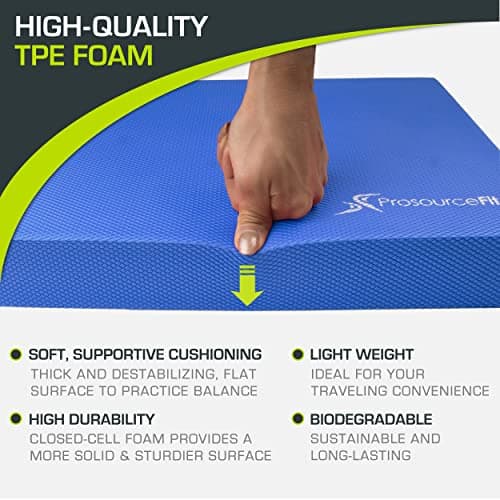
The TPE material genuinely repels sweat. I did not expect to be impressed by this, but after a particularly humid session that left my yoga mat looking like a topographic map, the balance pad looked almost untouched. A wipe with a damp cloth and it was done.
Where the pad falls short is under heavier loads. I weigh around 185 pounds and on longer balance holds — say, a single-leg deadlift held for 20 seconds — the foam compressed enough that the instability effect felt muted. Users over 200 pounds will likely notice this more. The listing does not address this, which is a minor honesty gap.
Who Should Buy It?
- Beginners to balance or proprioception work — the pad adds just enough difficulty to train stabilizer muscles without being intimidating
- Yoga practitioners who want to increase the challenge in standing poses or hand plank variations
- People recovering from ankle or foot injuries — PTs frequently recommend unstable surfaces for rebuilding proprioception after sprains or post-surgical rehab
- Anyone who stands at a standing desk — the pad works surprisingly well as a foot cushion to reduce fatigue
- Lightweight home-gym users who want to add variety to dumbbell and bodyweight circuits without buying expensive equipment
Skip this if you weigh over 200 pounds and plan to do extended single-leg balance work — the foam compression will rob you of the instability you are paying for. Also skip it if you want a thicker, firmer surface for high-impact exercises; look instead at rigid wobble boards or thicker air-filled balance trainers.
Alternatives Worth Considering
- TOGU Dynair — a rounder, pillow-shaped balance tool with more compression resistance. Costs more but holds up better for heavier users and is widely used in physical therapy clinics.
- ACETool Balance Pad — similar TPE construction at a comparable price point. The main difference is a slightly thicker profile that some users prefer for yoga and meditation use.
- Rabelly Balance Board — a wooden rocking balance board rather than a foam pad. Offers a more dynamic instability challenge but requires more skill and is not as portable.
FAQ
It's constructed from TPE (thermoplastic elastomer), an environmentally conscious material that is non-toxic, sweat-proof, and slip-resistant. It does not contain the latex found in some cheaper foam pads.
Final Verdict
The ProsourceFit balance pad earns its keep as a versatile, affordable addition to a home fitness setup. It is not flashy, it does not overpromise, and it does the specific job of creating an unstable training surface without complaint. The sweat-proof TPE, lightweight build, and multi-use design make it easy to justify the purchase even if you only use it a few times a week.
The one real limitation is compression under heavier body weights, which softens the instability effect over longer holds. For users in the 120 to 190 pound range, this is a non-issue. For heavier users, budget an extra $20–30 for a firmer alternative like the TOGU Dynair.
Will I keep using it? Probably — the standing-desk foot pad use case alone has already made it worth the shelf space it takes up.